
 
|
The NAQCC November 2026 Challenge NAQCC Monthly Challenges are originated and information regarding rules, ideas, or suggestions go to Gary K1YAN. Email him at  . .Challenge results and the Challenge App (the online Challenge tracking and reporting application) is administered by Charlie N1AOK. Email him with any questions at  PLEASE SEND ALL CHALLENGE SUBMISSIONS TO CHARLIE!!! (If you use the online Challenge App, it will automatically send it to him). LINKS: Challenge App: http://naqcc.wb5rvz.org Challenge Worksheet: challenge_tracker.pdf THE RADIO ROOM CLOCK 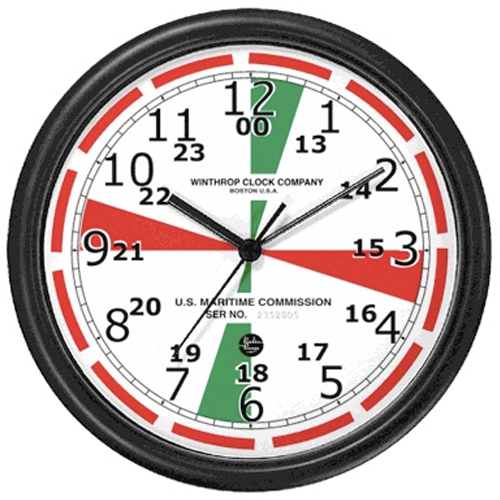 PREMISE: The International Radio Conference of 1912 followed on the heels of the sinking of the Titanic. This set the stage for the requirement that ships carry equipment for two way communications on both the 600 and 300 meter bands. Just 300 meters could be used on ships too small for a 600 meter transmitting antenna. The vessel did have to be able to monitor 600 meters even if transmitting was not possible. 600 meters was a busy band and it was possible that distress calls could be covered up by other traffic. To avoid missed distress calls, a mandate was given, requiring all ships operators to listen and not transmit for the first ten minutes of each hour. A later conference modified this mandate to require two silent periods per hour, each lasting three minutes. They would begin at the 15th and 45th minutes of the hour. During these times only distress transmissions were permitted. 2.182 mHz would become a radiotelephone service assignment and carry distress call as well as other traffic. To provide an additional measure of safety, two three minute monitoring periods were established at the hour and at half past the hour, similar to what was done on 600 meters. A further enhancement to ship safety came with the introduction of an automated distress system. A specific string of twelve four second long dahs separated by one second would trigger an alarm that sounded in the radio room, in the radio operator quarters and on the bridge. Provision was made for automatic sending of this code, but sending the alarm manually was also possible. The alarm was sent by A2, a modulated tone, rather than the normal A1 on/off carrier signal. So what does this have to do with the radio room clock? The clocks, you may have seen, with red and green markings on the face were made to help the radioman comply with these safety requirements. Two red sectors, from 15 to 18 minutes after the hour and from 45 to 48 minutes after the hour, mark the silent period used to listen for distress calls. Two green sectors, from the hour to 3 minutes after the hour and from 30 to 33 minutes after the hour, mark the silent period for 2.182 Mhz. The series of red dashes around the face of the clock mark the twelve, four second dahs with a one second spacing that set off the automated distress system. They are there to provide a guide for correctly sending the distress sequence. TIME FRAME: The first day of the month 0000Z through the last day of the month 2400Z. RULES: Just make these words from calls of stations you work, subject to the General Challenge Rules. INTERNATIONAL RADIO CONFERENCE OF 1912 TWO SILENT PERIODS AUTOMATED DISTRESS SYSTEM RED AND GREEN SECTORS The 91 total letters contain these 20 different letters: A C D E F G I L M N O P R S T W Y 1 2 9 You can use each letter in a call TWICE. For example you could use K3WWP for 2 K's, 4 W's, and 2 P's. Subsequent QSO's with the same station cannot be used for additional letters. For example, no matter how many times you work K3WWP, you can only use his call for 8 of the letters in the words. See General Rule #5 for more details on what callsign letters can be used. If you need some help with your alphabet challenge record keeping take a look at our Alphabet Tutorial page for everything from some great pencil & paper methods to fully computerized tools. AWARDS: A certificate and Participation Point go to everyone making all the words and submitting their report before the deadline. A Participation Point goes to everyone making at least 1, but not all the words and submitting their report before the deadline. YOU MUST COMPLETE AND SUBMIT AT LEAST ONE WORD TO RECEIVE A PARTICIPATION POINT! LOGS: For your report, list the words you made and the station used for each letter in the word. The number of stations listed must be the same as the number of letters in each word, even though you use the same station for more than one letter as in: WORD - K3WWP N2OD WA8REI N2OD NEXT - NF8M W8REI N8XMS K9EYT (Note how N2OD is listed for both the O and D.) You may also include comments about the challenge. Please preface any comments you want posted with "SOAPBOX:" so we will know what you want posted and what is private. Send your results as text in the horizontal format shown above to Charlie N1AOK at: charlie.wilber AT gmail.com (You must type that address into your email program.) Subject must read: (your call) NAQCC (month year) Challenge For example: K3WWP NAQCC November 2026 Challenge All entries must be RECEIVED before the 10th of the following month at 2400Z. |